Wednesday, July 13, 2011

The New Adventures of Old Tamale

On the road to Tamale
I’ve been counting down the days to this.  Not that thunderstorms, tigernut cocktails and weekend stays at oceanside eco lodges haven’t kept me busy – my stay in Ghana has been a fascinating combination of experiences both new (opening a coconut with a machete) and surprisingly normal (watching too many episodes of The New Adventures of Old Christine while dogsitting for a friend).  But I’m not here just to drive around with locals to chop bars with dancehall music blaring out the open windows to join in the cacophony of Accra streets.  Certainly part of the fun, but not the goal.

I’ve been talking up the Bankers without Borders program to MFIs across Accra, and this is finally my chance to watch it in action.  The Grameen Foundation asked me to shadow a BwB project for a partner MFI called Grameen Ghana in the northern city of Tamale (surprisingly no affiliation despite the shared namesake.)  A volunteer from an investment bank in NYC, Noah, is delivering training on a new financial model over a 4-day assignment.  This is only the second time this Grameen Foundation model has been passed on to another MFI, but BwB hopes this will eventually lead to a standard for financial projections across the industry.
Donkey by the Swimming Pool -
 now the working title of my first novel.

My role on the project varies depending on who you talk to.  BwB would like me to evaluate the project from both volunteer and client perspectives with an objective third eye.  Not having a chance to introduce myself during the kick-off meeting with the MFI, however, gave the director the opportunity to task me with a different role.  “And Noah has brought this pretty woman”, he announced to the team, “so everything we do will be prettier”.  Challenge accepted.

Tamale is a wonderland of NGOs, motorbikes and donkeys.  Okay, I’ve just seen the one donkey, but stumbling upon him and a massive turkey lounging near the swimming pool as I walked to my “hotel room” was noteworthy.  Londoners and New Yorkers would immediately understand what it’s like to leave the stress of Accra and feel the welcoming arms of the countryside.  The sky is bigger, the air easier to breathe, the day easier to enjoy.  The Northern region is predominantly Muslim and host to over 30 different ethnic groups, yet Tamale easily maintains the friendly and laidback life so characteristic of Ghana.

Four days is a short amount of time for a complex project like this, especially when the employees gleaned that Noah is a goldmine of information and asked him question after question about Excel.  While Noah was showing them a few shortcuts, I felt like I was at a party watching the popular guy do card tricks. You really don't hear “oohs” and “aahs” or laughter during Excel presentations at home. Early tomorrow morning we will travel three hours north to Bimbilla to meet with Grameen Ghana borrowers in the field.  Apparently the distance is only an hour’s drive, but the potholes really slow you down.  It will undoubtedly be an incredible day, even if my butt is bruised at the end of it.

As I write this, I’m watching the donkey from my little hut.  He’s using one of the pool umbrellas to scratch his head, making it look a bit like he’s wearing the umbrella as a hat.  It’s 5:30 in the morning, the sun is coming up and I can hear trucks and motorbikes passing by on the road from Kumasi.  I keep asking myself: in a few weeks’ time, will I believe I was ever here?


Mosquito bites: Still in the twenties.  Got a nice fresh set of 9 up and down my back.   Seems I'm single-handedly feeding the population here.
Waiting 10 hours for the flight to take off was surprisingly fun.
Best "only in Ghana: sight this week:  I showed up for my Antrak flight to Tamale at 4:30am as I was warned that the 6am departure could actually mean 5:30 (perpetually late Ghanaians manage to get flights off the ground EARLY??).  Sat in the departure lounge until about 5:30 when we were all shuffled through security (the pat down was so thorough I blushed).  After about half an hour in the gate, a man in a neon vest announced to the group that the flight had been delayed until about 1pm because of storms in Tamale.  Noah and I headed back to town, got some breakfast, went to the mall, and got back to the airport around noon.  We had a quick beer at the airport bar but made sure to get back to the gate in time for departure. An hour passed in the departure lounge. Then another.  Around 2:30pm, like sweaty cattle, we all made our way through security to the gate.  And sat for another hour.  Finally around 4pm, almost 12 hours after the departure time, we took off.  The most amazing thing about this whole process is that apart from the announcement I mentioned, not a word was said.  Noah and I were cued only by the sudden rush of people from one place to another.  How did they know?  What did I miss?  The views from the flight, however, were stunning.  Felt like I was in the back of Denys Finch Hatton's plane, looking down on the glorious greenery.

Thursday, June 30, 2011

Green Means Growth

Ghana moves slowly.  Meals at restaurants can take an hour to arrive and the mud sidewalks are crowded with ambling pedestrians who stop to chat frequently.  Last night a friend told me about checking in on an item he had ordered from a vendor; when he asked when it would be ready, the response was, "for sure maybe tomorrow."  This is at once the most wonderful and most frustrating characteristic of Ghanaian life.  Something I really wanted to do on this trip was meet at least one microfinance client to see for myself if a small loan really made a tangible difference.  Recognizing the sluggish speed of life and acknowledging my short time here, I wasn't too optimistic that I'd get the opportunity.  But as those who have come to know Ghana understand, things have a way of working out in ways you can't anticipate.
The view from Hillburi, Aburi

The first MFI I met with last week was impressive from the moment I entered the office.  I did not expect them to be in a five-story office building with glass walls and cubicles, nor did I think that my flip flops and sundress would render me embarrassingly underdressed.  A team of three men in sharp suits, including the CEO, ran me through a well-prepared Powerpoint on their background and operations.  They base their banking on mobility; that is, their loan officers each have a mobile phone and a mobile printer through which they can serve hundreds of customers in remote villages throughout their target regions.  Customers receive a printed receipt while their information is sent from the phone back to an impressive information management system (that the company developed internally) so that the head offices can keep track of individual balances, outstanding loans, and agent collections.  This model is limitless, especially in terms of reaching customers in remote areas who lack access to financial services the most.  After an hour or so I thanked them for their time, and left the meeting more than satisfied.

The next day I received an e-mail from the CEO who asked if I would accompany him on a day trip outside of Accra to visit the branch there and observe their interaction with customers.  This, as it turns out, barely begins to cover what we did on that day trip.  The two hour drive began with traffic and dust and potholes but ended in the beautiful mountains of the Eastern Region.  Our first stop was to meet the branch manager in Nkurakan, a smart young woman who oversees a number of villages in the area.  The three of us then moved on to the next village, where I was introduced to Emmanuel.  Emmanuel owns a business called Greenfield Spare Parts ("why greenfield?" I asked. "green means growth.") and has taken a total of approximately $1,500 in loans.  When the warehouse he buys his parts from increased their prices, he was worried he wouldn't be able to complete his stock and business would plummet, but this loan ensures that he is able to continue serving his customers the way he needs to to stay afloat.  When I asked if he would continue to take out loans, he grinned and said "of course, of course.  I am so grateful."
Wish this picture had captured how incredibly hot it was.

From there we moved from village to village to meet with people, finally ending at a huge trader market.  Huge.  Everything you could imagine was sold here, from dried Tilapia to toenail scissors to second hand trousers.  The MFI hosts a stall with a DJ and computers, and volunteer agents walk throughout the market to visit with existing customers and invite new ones to register at the stall.  One staff agent grabbed my hand and led me through the market, introduced me to clients (all women), invited me to try fruits I'd never seen before, and told me how much he loves his job.  I could go on and on about this trip - about how one customer whose business in a wood shack had been robbed and a loan allowed him to buy a more secure tin shack, about how the CEO is incredibly smart and sees only growth for their company, or about an amazing lunch in the mountains at this place, but there are other stories to tell.

The next day, a different MFI invited me to attend a group lender meeting and a group leader training.  This MFI aims to serve the urban poor, referring to their clients as partners, and while they lend to individuals, these partners must be part of a community-formed group.  These groups hold weekly meetings to discuss any issues and ensure everyone is paying back their loans.  The group I visited with was named "God is Good" - which also served as a chant the leader shouted out multiple times to the group's collective response "all the time!"  As the leader went through the agenda, the treasurer of the group collected everyone's payments in a lady's purse hung around his neck.  On a personal note, I love watching group interactions like this.  They teased each other (a conversation I thought was a serious discussion on the tardy policy was actually one guy asking the group if the ring on my finger meant I was married or available), and laughed and clapped when I said thank you in Twi (Medase!), and prayed in earnest to start and close the meeting.  This MFI's customers are 98% women who typically borrow about $80, and each client must undertake mandatory training before leveraging the MFI's loans or savings products.

Anthony, a customer, in front of his business.
These stories have been encouraging.  Microfinance certainly has a place here and seems to be in a state of development.  But a hard fact remains: the number one challenge facing all of these institutions is the lack of funding and financing.  Some are donor dependent, some rely on investments from personal contacts, some seem to have no long-term sustainability plan.  I have also noted a lack of collaboration among these organizations, which ultimately means that the sector suffers from a lack of best practices and self-regulation.  Looking forward, many of these MFIs hope to tap into new sources of income and explore how technology can expand their operations.  Previously ignored by the Bank of Ghana, MFIs will be boosted by the launch of a new Central Bank microfinance division by the end of the year.  Will this be a catalyst for MFI sustainability and growth?  For customers like Emmanuel and the members of "God is Good", I certainly hope so.


Mosquito bites: 22 (mostly on my feet)
Best "only in Ghana" sight/sound this week: Last Friday I had my first tennis lesson at the courts behind the National Stadium.  Sule, my Nigerian instructor, is patient and calm and I love hearing him say things like "Keem, we will work on your foh-hond" or "Let me be moh cle-ah, you must bend yo kneees!"  What was not as calm, however, was the swarm of little kids on the court who were desperate to be our ballboys (or friends?)  Innocently obnoxious and desperate for some action, they were prancing around the entire perimeter of the court so loudly I could barely hear the balls hit my racket.  After the lesson I made friends with an 8 year old boy wearing an Oakland t-shirt.  I taught him a high five low five, and he taught me a fist bump.  Fist bumps on the tennis court...Wimbledon, this is not.

Monday, June 27, 2011

KKT's Ghanaian Rules of Thumb

You're welcome.


wait...which way?
Getting Around
Planned to go to a restaurant the other night, got these official directions in the guidebook: "If coming from the airport area, cross the railroad track, follow road as it turns, take the 2nd left. This road will go over a small "river", then take first left - opposite a signboard that reads "cape 3 office". The restaurant is in a house, on right side, painted mustard yellow. There is no name on the house." I skipped dinner.  


You can sit anywhere you like, really.
Taxis are a pretty convenient way to travel if you don't mind haggling with the driver for a fair price (minus what my friend calls the "white man tax".)  Sit in the front seat and put on the seatbelt, if there is one.  The driver will honk throughout the speedy journey for no apparent reason; he may be saying "Get out of my way, pedestrian!", or "I'm available for a passenger", or perhaps just "look at me! I'm driving!" If it seems like the car is falling apart, it is.  One of the doors or something on the bottom of the car is sure to be rattling loudly, hopefully in time with the driver's honking to make up for the ominously missing radio.  If the door doesn't open from the inside, half of the time it won't, just act cool and open the door from the outside.  And always be friendly - drivers are happy to share directions and talk about their favorite football team.  If you don't feel like chatting, enjoy them singing along loudly to hiplife or a skipping CD of the greatest hits of Celine Dion.


Electricity
If you are taking a cold shower at 3am, because your body temperature hits an unsleepable degree, and the power goes out (usually a very dramatic whirr into silence) - do not panic.  Enjoy the shower in the darkness and most likely, by the time you are done, the security guards will have figured out how to turn on the generator after a few loud arguments and many mysterious banging sounds.  Why does the power go out so frequently here?  Grossly deficient infrastructure.  It's the same reason that the streets are lined with tunnels of dirty water pouring into the ocean. Which brings me to another point - open defecation is practiced often here, even by women.  Watch where you're walking.  And please don't take part.


Sounds of the Night
Loud banging to fix the generator will be only one of the nighttime sounds you'll hear while laying in bed in a pool of sweat.  Church services take place in the middle of the night and worship is just as loud as it would be at a more appropriate hour.  Funeral processions will clang past your complex at 5 in the morning with chanting and drumming and bells that seem to follow no particular rhythm.  Frogs and crickets and birds and something making a sound that can only be described as Michael Jackson's signature "ee-eeee!" will also join the chorus.  It may seem like you'll never get to sleep, but don't worry, the heat will eventually ease you in to a soundless coma.


Food and Cooking
bug free breakfast.
Some of the juiciest mangos, passionfruits and papayas can be found in Ghana.  Adequate vegetables can also be found at stalls on the street, and yes, they will be covered in little bugs and flies.  You can get vegetables without inhabitants at the grocery store if you're willing to pay $3 for an onion (turns out, I am.)  Before you put everything in the fridge - forget everything you've learned about avocados and tomatoes and bananas not needing refrigeration - slice them all up to make sure the bugs have an escape route.  The simplest meal at home will take you twice as long to cook here because you have to inspect everything, cut out the questionable bits, and wash and cook every piece.  Or, if you feel confident in your ciprofloxacin medicine, go ahead and live dangerously and bite in to that fresh tomato.  What's the worst that could happen?


Marriage Proposals
Women with low self-esteem could use Ghana as a sort of rehab.  The catcalls of construction men in the Western world don't compare to the charm and persistence of Ghanaian men.  Men will tell you they love you, tell you they want to be close to you, offer to do anything for you and take you anywhere, ask you to be their wife or their Facebook friend before you've even had a chance to say hello. Responses like "I have a boyfriend" or "But you don't know me" won't put them off, but don't be rude. If two men in a car are driving slowly alongside you as you walk, stop and chat with them and firmly tell them that you are on your way somewhere. I conveniently leave my phone at home and refuse to memorize my phone number. Getting their information ends the conversation (if you're lucky) and leaves it in your hands. If you do give your number out, expect to receive phone call after phone call from men asking repeatedly "how are you?" They are not being sleazy, they just really want to know how you're doing.


The Fun Things
You can show up late to meetings and you'll probably be the first one there.  Handshakes here are almost as fun as high fives (with a clicking of each other's middle fingers).  Jollof rice is tasty.  Big beers are cheap.  The clothes are wild.  Life is lived out on the streets.  And everywhere I go, I am welcomed.

Monday, June 20, 2011

Kokrobite

any guesses?
From tequila shooters to Rastafaris to Ghanaian police officers, the first weekend here was exactly what I hoped it would be.  Left the office early on Friday and roamed around the Artist's Alliance with Lynda and some other volunteers - a three story building with some fantastic Ghanaian art and crafts. What followed was, thus far, the highlight of my trip.  David, a Ghanaian Grameen employee who just moved back here from India, invited us out to a dinner at a seafood restaurant with a few friends.  About 12 of us finished 9 bottles of wine and 9 platters of various (some unidentifiable) seafood dishes, including swordfish and clams and octopus. As a girl who turns her nose up at fish I have to bone myself, I am proud to say I tried every single dish, lobster was the one exception, and I really enjoyed the meal. Afterwards, we sat outside at Venus, a hookah bar in the Osu district, where a South African taught me how to do tequila shooters. From there we moved to Bella Roma, a nightclub populated with locals, and danced the night away. I returned home around 4:30 and went to sleep feeling totally confident that I'd make my 8:30 yoga class.

Big pile of bikes in front of police station.
I did not. But by noon or so, David, Lynda and I made our way to Kokrobite. For an 18 mile distance, the journey was long. Funeral processions, commonly held on Saturdays, only added to the perpetual traffic in Accra. We finally picked up speed, but my tired eyes perked up at the sign pointing to Kokrobite just a little too late, and David had to make a debatably illegal u-turn to go back to the turning. What a mistake. A young police officer standing on the road pulled us over, motioned for me to move my backpack over so he could get in the backseat with me, and nonchalantly demanded we drive to the nearest police station. I was told the night before (by an Australian) that this is simply how it's done here.  Bribes are common, but we were too good hearted for that.  Earnest Lynda asked the officer for forgiveness, but the officer just chuckled.  Apparently you have to buy forgiveness here. We waited for 15 minutes at the police station while David worked his Ghanaian magic, and soon we were back on the road without having to pay a fine. David guessed that the police officer most likely just needed a ride back to the office. Terrible system, but fun to observe.

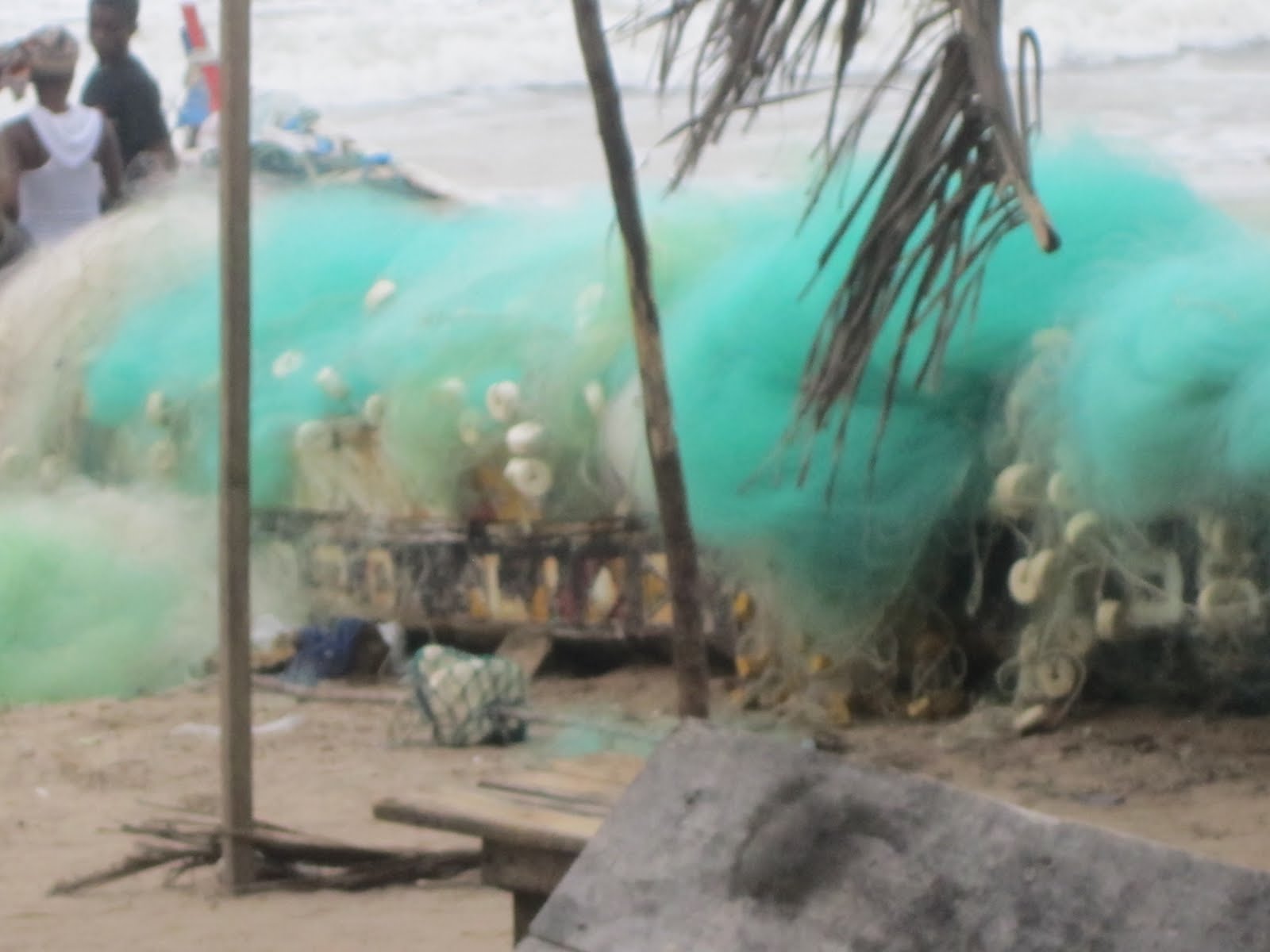
The nets on the fishing boats at Kokrobite
Our journey's surprises didn't stop there. A recent storm had created crater-size potholes in the long red mud road to the ocean.  It was slow going, but we finally arrived about 3 hours after we had set out.  Our destination was Big Milly's Backyard - a little enclave on the beach with a pervasive Rastafari culture and the perfect set up for relaxation.  Milly's was kind to us.  We ate traditional dishes like Red Red (bean stew and plantains) and groundnut soup while observing fishermen pull in their boats and women with babies tied to their backs sell pineapples and biscuits.  We took a drumming lesson and the three of us each bought drums to continue our vocation independently.  I also bought shaky balls - the Ghanaian version of maracas, but much harder to play. We stayed at the Dream Hotel in a room with a doorless bathroom and a flooding toilet. We drank a white wine called Obama of Africa and we danced to a Reggae band with the locals.  Ghana at its finest.

I am writing this now from my apartment just behind the Grameen office.  I have hot water, various foods in the fridge, a mosquito net, and semi-reliable internet access. I really couldn't ask for more. I am eagerly awaiting the week ahead, when I finally get to start meeting directors at microfinance institutions in person! I'm also hoping to dedicate some time to my drumming, take my first Ghanaian tennis lesson, and persuade some of the people I've met to join me at a pub quiz night this week. Getting settled certainly takes some time, and I imagine there will be ups and downs along the way, but tonight I am content.

Mosquito bites: 7
Lynda, Stephan, and said smoothie
Best "only in Ghana" sight/sound this week: A Ghanaian man named Stephan kindly offered us a ride back to Accra from Kokrobite in his Jeep.  Stephan runs an organization called Foundation of Hope, and talked excitedly about what he does, how much he has learned from his volunteers, and what he would like to see changed in his country.  When he heard I was looking for a bicycle, he offered to drive one down to Accra for me today.  Refusing to let us pay him for the trip, he allowed us only to buy him a smoothie to say thank you.  Only in Ghana can you get in a stranger's car and end up getting a free bicycle delivered to you at the end of the ride, all for the price of one smoothie.