Monday, June 20, 2011

Kokrobite

any guesses?
From tequila shooters to Rastafaris to Ghanaian police officers, the first weekend here was exactly what I hoped it would be.  Left the office early on Friday and roamed around the Artist's Alliance with Lynda and some other volunteers - a three story building with some fantastic Ghanaian art and crafts. What followed was, thus far, the highlight of my trip.  David, a Ghanaian Grameen employee who just moved back here from India, invited us out to a dinner at a seafood restaurant with a few friends.  About 12 of us finished 9 bottles of wine and 9 platters of various (some unidentifiable) seafood dishes, including swordfish and clams and octopus. As a girl who turns her nose up at fish I have to bone myself, I am proud to say I tried every single dish, lobster was the one exception, and I really enjoyed the meal. Afterwards, we sat outside at Venus, a hookah bar in the Osu district, where a South African taught me how to do tequila shooters. From there we moved to Bella Roma, a nightclub populated with locals, and danced the night away. I returned home around 4:30 and went to sleep feeling totally confident that I'd make my 8:30 yoga class.

Big pile of bikes in front of police station.
I did not. But by noon or so, David, Lynda and I made our way to Kokrobite. For an 18 mile distance, the journey was long. Funeral processions, commonly held on Saturdays, only added to the perpetual traffic in Accra. We finally picked up speed, but my tired eyes perked up at the sign pointing to Kokrobite just a little too late, and David had to make a debatably illegal u-turn to go back to the turning. What a mistake. A young police officer standing on the road pulled us over, motioned for me to move my backpack over so he could get in the backseat with me, and nonchalantly demanded we drive to the nearest police station. I was told the night before (by an Australian) that this is simply how it's done here.  Bribes are common, but we were too good hearted for that.  Earnest Lynda asked the officer for forgiveness, but the officer just chuckled.  Apparently you have to buy forgiveness here. We waited for 15 minutes at the police station while David worked his Ghanaian magic, and soon we were back on the road without having to pay a fine. David guessed that the police officer most likely just needed a ride back to the office. Terrible system, but fun to observe.

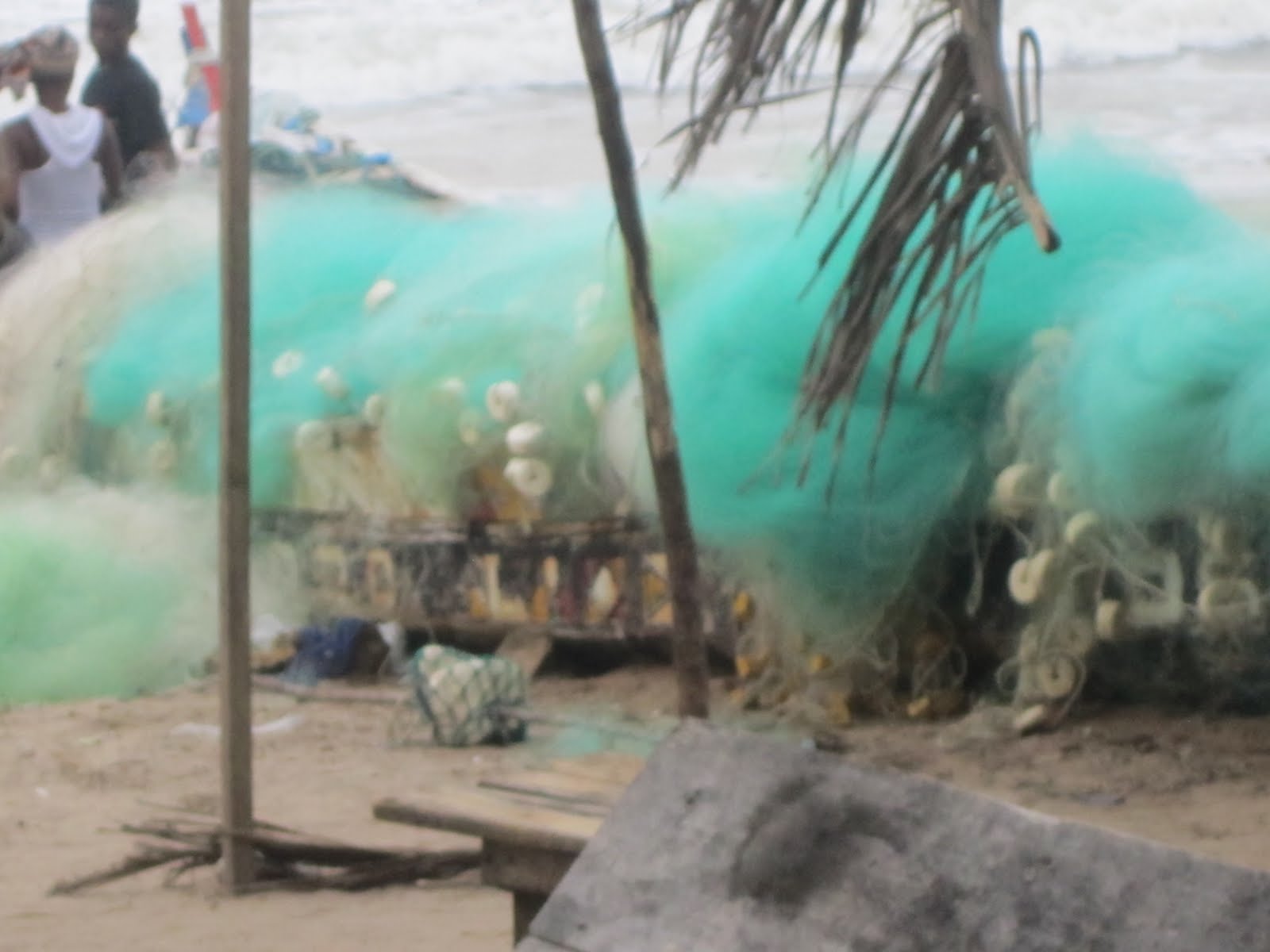
The nets on the fishing boats at Kokrobite
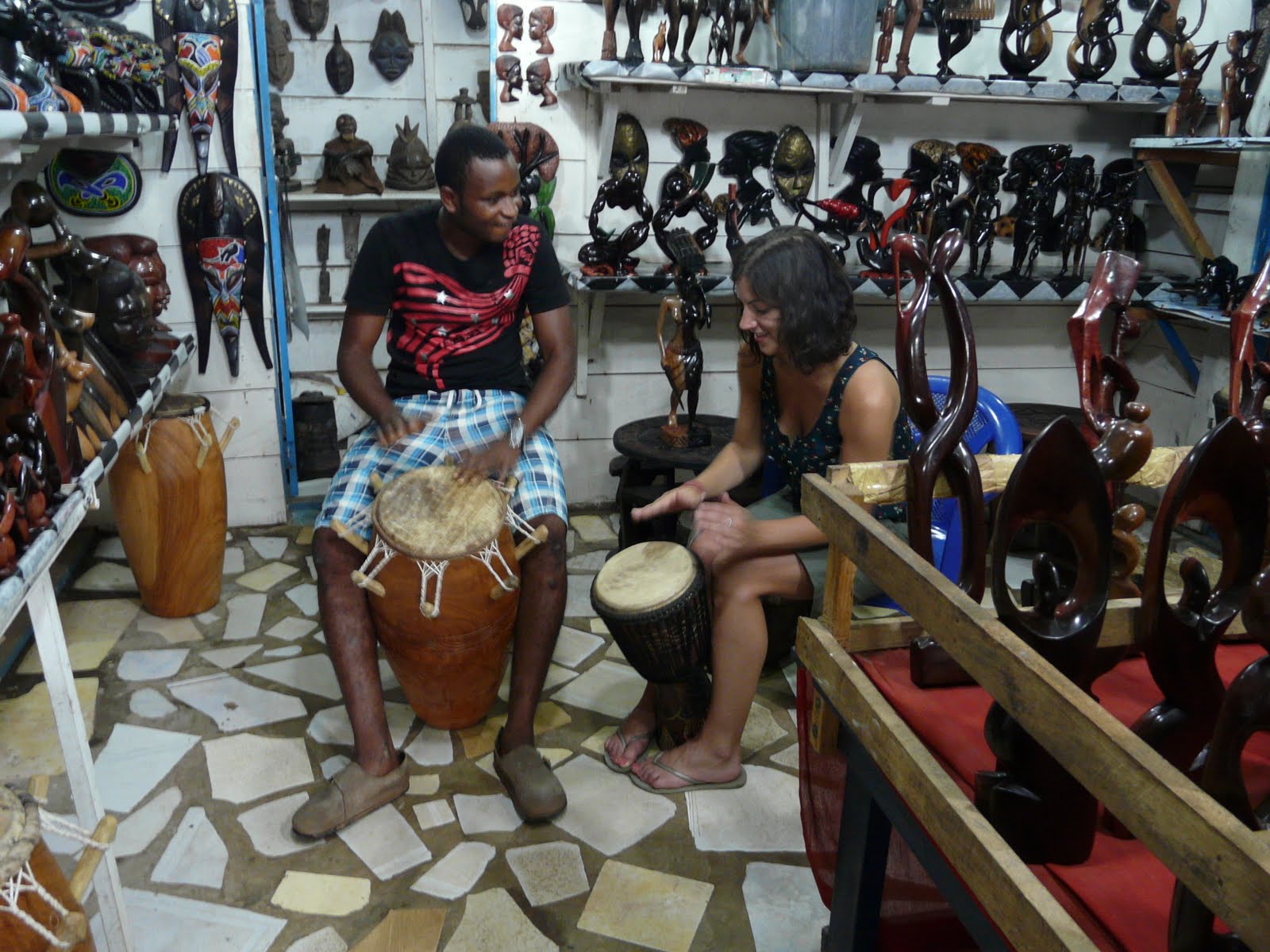
Our journey's surprises didn't stop there. A recent storm had created crater-size potholes in the long red mud road to the ocean.  It was slow going, but we finally arrived about 3 hours after we had set out.  Our destination was Big Milly's Backyard - a little enclave on the beach with a pervasive Rastafari culture and the perfect set up for relaxation.  Milly's was kind to us.  We ate traditional dishes like Red Red (bean stew and plantains) and groundnut soup while observing fishermen pull in their boats and women with babies tied to their backs sell pineapples and biscuits.  We took a drumming lesson and the three of us each bought drums to continue our vocation independently.  I also bought shaky balls - the Ghanaian version of maracas, but much harder to play. We stayed at the Dream Hotel in a room with a doorless bathroom and a flooding toilet. We drank a white wine called Obama of Africa and we danced to a Reggae band with the locals.  Ghana at its finest.

I am writing this now from my apartment just behind the Grameen office.  I have hot water, various foods in the fridge, a mosquito net, and semi-reliable internet access. I really couldn't ask for more. I am eagerly awaiting the week ahead, when I finally get to start meeting directors at microfinance institutions in person! I'm also hoping to dedicate some time to my drumming, take my first Ghanaian tennis lesson, and persuade some of the people I've met to join me at a pub quiz night this week. Getting settled certainly takes some time, and I imagine there will be ups and downs along the way, but tonight I am content.

Mosquito bites: 7
Lynda, Stephan, and said smoothie
Best "only in Ghana" sight/sound this week: A Ghanaian man named Stephan kindly offered us a ride back to Accra from Kokrobite in his Jeep.  Stephan runs an organization called Foundation of Hope, and talked excitedly about what he does, how much he has learned from his volunteers, and what he would like to see changed in his country.  When he heard I was looking for a bicycle, he offered to drive one down to Accra for me today.  Refusing to let us pay him for the trip, he allowed us only to buy him a smoothie to say thank you.  Only in Ghana can you get in a stranger's car and end up getting a free bicycle delivered to you at the end of the ride, all for the price of one smoothie.


Thursday, June 16, 2011

Microfinance: Not a cure-all

While I'd love to bore you all* with stories of questionable foods, house lizards and Ghanaian taxi drivers (and promise to do so very soon!), I'm choosing instead to get the ball rolling by sharing a bit about what I'll be working on this summer.  I've begun two out of five projects this week - one is researching current linkages between mobile technology and agriculture (to inform a pilot Grameen Foundation initiative) and the other is researching the state of microfinance in Ghana.

Compared to other African countries, Ghana has a relatively developed field of microfinance with over 40 institutions providing loans of $130 million to about 350,000 customers.  As expected, I've encountered arguments, some bitter and some worthy, over what works and what doesn't.  High interest rates, inclusive and short-term financial models and an immense funding gap threaten the livelihood of the sector in certain areas.  Some critics go so far as to say that microfinance even perpetuates poverty by offering "second-rate" financial services to the poor.  The problems with arguments against microfinance, as I see it, are as follows: 1. Microfinance cannot be viewed as a cure-all for poverty, and 2. critics tend to examine microfinance in its current state and fail to acknowledge the evolving nature of financial services for a complex group such as the poor.

Ever since Mohammed Yunus made that first $27 loan thirty five years ago, microfinance has burgeouned into its own professional field accompanied with declarations that this is the solution we've all been looking for.  Critics who warn that microfinance isn't all it's cracked up to be are usually reacting to blanket claims made by professionals in the field that microfinance is the only way to solve poverty effectively.  (They do this in part to attract donor money, and you can't blame the players in the tricky game of fundraising.) But to state that microfinance is having little impact on conditions of the poor is ignorant at best, and these black-and-white generalizations - on either side - do nothing to further positive development.  It's like saying that the eradication of AIDS will not lift all people out of poverty.  Clearly that is the case, but does it mean that agencies dedicated to seeing the end of the disease should just quit their jobs and head to the beach?  Of course not.  The truth is that poverty is a deep, complex problem entrenched in history and societal standards, and no one thing could ever blot out the horrific conditions of the poor.

Because of this, microfinance cannot exist in a vacuum.  The sector is well positioned, especially in well-developed markets, to serve as a tool to enable all other functioning models of development, like healthcare, education, food security and access to water (saw a great Austrian film on water at the Goethe Institut on Monday: Uber Wasser.)  MFIs need to have the capacity to create strong ties across sectors to develop a sector worthy of investment in order to penetrate massive societal challenges.

There are several cases of pioneering models.  Companies seeking to strengthen their value chains have partnered with microfinance organizations, as Unilever has done in India.  MFIs and development organizations can team up with established banks, like the partnership between CHF International and HFC Bank or Barclays Banks' work with susu collectors here in Ghana.  Governments can assist microfinance sustainability by not placing ceilings on interest rates and promoting competition.  Innovation, technical expertise and technology will also push the sector into addressing more than just the financial needs of the poor, and that is where services from organizations like the Grameen Foundation come in.  Microfinance will not save the world (can anything really?) but it is certainly one big and helpful step in the right direction.  As I begin to conduct in-person interviews with MFI staff and customers on the ground here, I look forward to sharing their views on what microfinance has accomplished, and what the future of the sector looks like here in Ghana.


(*or just my mum, since she's most likely my one reader.  Hi mum!)

Sunday, June 12, 2011

Announcements, Emergencies and Fumigation*

My journey yesterday started at 4am.  One car trip, boat ride, train trip, taxi ride, and a flight later, I was sitting on the floor of a gate crowded with Ghanaians at Schiphol airport in Amsterdam.  When the KLM agent announced business class boarding for the flight to Accra, almost everyone stood up and crowded the entrance to the airplane.  "Business class only," she reminded them, "everyone else please sit down.  Please sit down!" A few stepped aside, but no one took a seat.  Every time she announced a specific section of seats ready for boarding, she would have to repeat the announcement to restrain the travelers crowding around her.  I was annoyed.  Why can't they follow directions?  I recalled a recent situation that had irked me similarly:  I was waiting in line in a small grocery store in Barcelona only to watch customer after customer cut in front of me to pay.  "Oh yeah," my traveling companion remembered, "they don't queue in Spain."
My German upbringing has left me with a need for a great amount of personal space and little patience for inefficiency.  The English part of me apologizes profusely for the most harmless bump into a stranger, and the Bay Area girl in me loves to talk about what the weather's going to be like tomorrow.  When I observe cultures where people do the opposite of what I do, my Dutch inclination to live and let live gives way to quiet resentment (or loud, as I share this in a public blog entry) as I think about how much better things would be if everyone did them the way I do.
What attributes would we want to emulate from each culture in a perfect world? Certainly not the Ghanaian laissez-faire attitude that had me hunting down my 24 hour visa when it hadn't shown up 6 days later.  Probably not whatever prompted the German at Frankfurt airport to look at me in disgust when I attempted ordering a Bockwurst in his language.  I for one could do without the English tendency to smother sunblock on like white paint, and abolish any culture in which foul body odors go unnoticed.  Am I being insensitive?  Absolutely, and that's my point.  Clearly it's easier to see what we don't like about other cultures rather than what we do like.  So, to get in the traveling mindset, I'm reminding myself that each culture is a national personality, and a celebration of history and tradition and identity.  Most importantly, whatever they're doing works for them.  If it doesn't work for me...why on earth am I traveling?
We landed in Accra and within moments, while the plane was still moving, people clicked off their seatbelts and started opening the overhead bins.  I was horrified.  "The seatbelt light is still on! Come on people!"  How I wished the flight attendant would berate them for not following protocol.  But she didn't...because this is not her first time to Accra.  In the airport, before I found my roommate, I heard a familiar sound.  Taxi drivers were hissing at me (tsssss!  tssss!), a culturally acceptable way to get someone's attention in Ghanaian culture.  The American in me thought "how rude", but the Ghanaian in me just turned and smiled.  Time to get acclimated.

(And yes, this is all a long way of saying I've arrived safe and sound. Accra is marvelous, and I will write more when I've soaked it all in.  For now, I will leave you with a picture of my impromptu drumming lesson at a market this morning.)


*Just a few fun little anecdotes from my journey.  A public announcement was made by the train driver upon our arrival into Waterloo: "The American girl who's napping may want to wake up now."  Then there was a medical emergency requiring a doctor on my flight to Accra, which ended with some kind of fumigation that is apparently now required on all flights to Ghana by the World Health Organization.  Sure smelled nice, though.

Thursday, June 9, 2011

Second Time Around


Almost three years ago, to the day, I was returning from my first trip to Ghana. I left there with a big hole in my heart because I knew it was unlikely I would ever return. Life certainly is full of surprises!  In under 48 hours (if my visa arrives tomorrow...) I will be on a noon flight back to the land of pygmy goats and Star beer. This time I'll be joining the Grameen Foundation in Accra, the nation's capital, to conduct landscape analyses of microfinance markets in Ghana and Kenya for their Bankers without Borders initiative. This program is designed to utilize private sector resources - namely volunteers with professional expertise - to build the capacity of microfinance institutions in order to help the poorest people throughout the world move out of poverty. Their program stood out to me when I was researching corporate engagement at the Taproot Foundation. They are clearly pioneers in leveraging volunteer resources effectively and innovatively for poverty reduction, and I feel incredibly lucky to work for them this summer.

I deliberated on reviving my blog for the sole reason that what I'm doing just isn't that extraordinary. Every day, hundreds of people are volunteering throughout the African continent - and the globe - sacrificing the conveniences of home and time with loved ones to hopefully make a stranger's life a little bit better. My story is no more interesting than theirs. While I will no doubt be sharing personal anecdotes and my perspectives on the day to day Ghanaian life, I'll also be seeing things through a newly refined policy lens (thank you, graduate school). Having researched corporate engagement and skills-based volunteerism for a few years now, I've had to wade through countless arguments over better practices and efficient models of service delivery. Does microfinance work? Can volunteers make a difference? Is anything we're doing really lifting people out of poverty? I hope to find out, and I hope that anyone who is interested will join the conversation.

I also hope to fall back in love with a land that has seemed so far away since I left! A lot has changed in the country since 2008 - now a middle-income status nation and currently tapping in to newly discovered oil - and a lot has changed in me. Will I still be greeted with shouts of "yevu!" and "I love you!" on the streets? Will tiny little goats follow me wherever I go? Will I get used to people showing up at 4pm for 1oam appointments? Will strangers invite me into their home and share their food and life stories with me?

Let's see.